 by: Wulfy
 Categories:
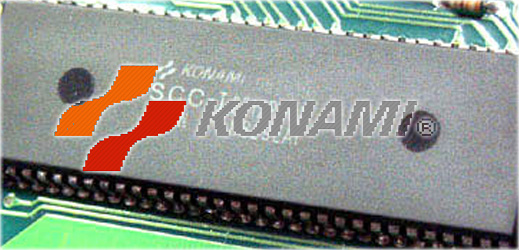
In Japan, 22 August 1987, Konami The first generation of MSX microcomputers was released a video game that was going to date. This game is Gradius 2 (Nemesis 2), a specific version for the MSX series Gradius output on arcade terminals.
Gradius 2 is exceptional at more than one title, gameplay and graphics are great for a MSX1 game, but the great strength of the game lies in its sound atmosphere.
Indeed, while so far, MSX users were content with music on 3 PSG tracks, certainly very beautiful for some, Konami was to add to his cartridge a chip known as CSC (of his real name « Sound Creative Chip » and not « Sound Custom Chip » As seen everywhere) to significantly improve music.
This CSC included 5 additional tracks that added to the 3 basic tracks, so the music in 8 voices of Gradius 2 signed Furukawa Motoaki (Konami Kukeiha Club) were simply sublime for the time.
CSC's 5 additional channels are said to be « Waveform memory » using synthesis « Wavetable » (in French, table donde) very different ways « PSG ». In music, table-done synthesis means that one can directly create the waveform of the instrument. To achieve this, a series of positive or negative values must be defined which will ultimately give the shape of the wave that will be repeated in a cyclical way.
Attention, the term « Wavetable » is often confused with the term « Wavetable » used at the time by PC sound card builders as Creative Labs But the latter corresponds to a table of samples (sound samples) and therefore has nothing to do with what has just been described.
Here is a small non-exhaustive list of machines that are equipped with table-side synthesis:
1) Konami bubble system (Arcade), SCC and SCC+ (MSX and arcade)
2) Namco C15/C30 (Arcade), N163 (Famicom cartridge extension)
3) Nintendo Famicom Disc System
4) Nintendo Game Boy, Nintendo Game Boy Advance
5) Neck PC Engine, Neck PC-FX
6) Bandai Wonderswan
Note: with respect to CSC, it has a particularity which makes the fourth and fifth tracks necessarily use the same instrument (there are therefore 4 possible instruments simultaneously)
Subsequently, Konami released a SCC+ (available in game cartridges) Snatcher and SD-Snatcher) which removes this limitation by allowing to play 5 instruments at the same time.
Let us now look at the technique:
We have seen that a series of values must be defined to define the desired wave. This number of values varies depending on the chips. For the CSCThis will define 32 successive hexadecimal values which can take the following values: 0 represents the median value, values 1 to 127 (01H to 7FH) are increasingly positive and values -1 to -128 (FFH to 80H) are increasingly negative.
– example to make a square wave:
7F7F7F7F7F7F7F7F7F7F7F7F7F7F7F7F7
F7F80808080808080808080808080808080808080
– example for making a saw tooth wave:
1010202030304040505060607
07080809090A0A0B0B0C0C0C0D0D0E0E0F0F0000
Published by popolon on his blog: Pasogaku